The QBCC Standards and Tolerances Guide is the document that quietly underpins almost every conversation about building defects in Queensland. When a buyer and builder disagree about whether something needs fixing, this is the reference that settles it.
What the Standards and Tolerances Guide actually means
Published by the Queensland Building and Construction Commission, the Standards and Tolerances Guide defines what acceptable residential building work looks like and the tolerances within which work is considered compliant. It is, in effect, the agreed yardstick for the question every new-home buyer eventually asks: is this a defect, or is it acceptable?
The guide covers a broad sweep of building elements — internal and external surfaces, tiling, paint and rendered finishes, brickwork, cabinetry, glazing, site drainage and more. For each, it describes what is acceptable and where the line into defective work lies.
Where it applies in your new home
The guide applies across the finished home, but it is most relevant at the points where quality is assessed — particularly at practical completion and during the defect liability period. Anywhere a finish, surface or element can be judged for quality, the Standards and Tolerances Guide provides the benchmark.
It is also relevant earlier, at stage inspections, where workmanship can be assessed against the same expectations before it is concealed by later trades.
What VG Inspect checks against the guide
An independent inspection uses the Standards and Tolerances Guide as the reference for separating genuine defects from acceptable variation. Rather than relying on opinion, each finding is assessed against the guide's criteria — is this surface variation within tolerance, or beyond it? Is this finish acceptable, or defective?
This discipline is what makes an inspection report useful. A defect list that ties each item to the relevant standard or tolerance is far harder to dismiss than a list of subjective complaints. Every finding is documented in writing with photographs and framed against the applicable benchmark.
Real defect examples — measured against the guide
Builders across South East Queensland produce quality homes, and most items raised at handover are routine. What makes a finding actionable is a measurement against the guide's tolerance rather than an opinion. The examples below show how the guide turns a judgement call into an objective one — each is photographed, located and measured on a VG Inspect report. Exact figures should always be confirmed against the current published edition of the QBCC Standards and Tolerances Guide.
Floor levelness. A finished floor that is out of level by more than roughly 10 mm across a room — or about 4 mm under a 2 m straightedge — typically falls outside tolerance. Below that, the variation is generally accepted as normal for a hand-built home.
Walls out of plumb. An internal wall leaning more than about 5 mm over a 1.8 m vertical measurement is generally beyond tolerance, whereas a smaller lean sits within the accepted range.
Wall and ceiling straightness. A bow or bulge greater than about 4 mm under a 2 m straightedge is usually defective; gentle variation under that figure is acceptable.
Tile lippage. A height difference between the edges of adjoining tiles of more than roughly 1–2 mm (depending on tile size and edge type) is generally outside tolerance — visible and easy to catch under raking light.
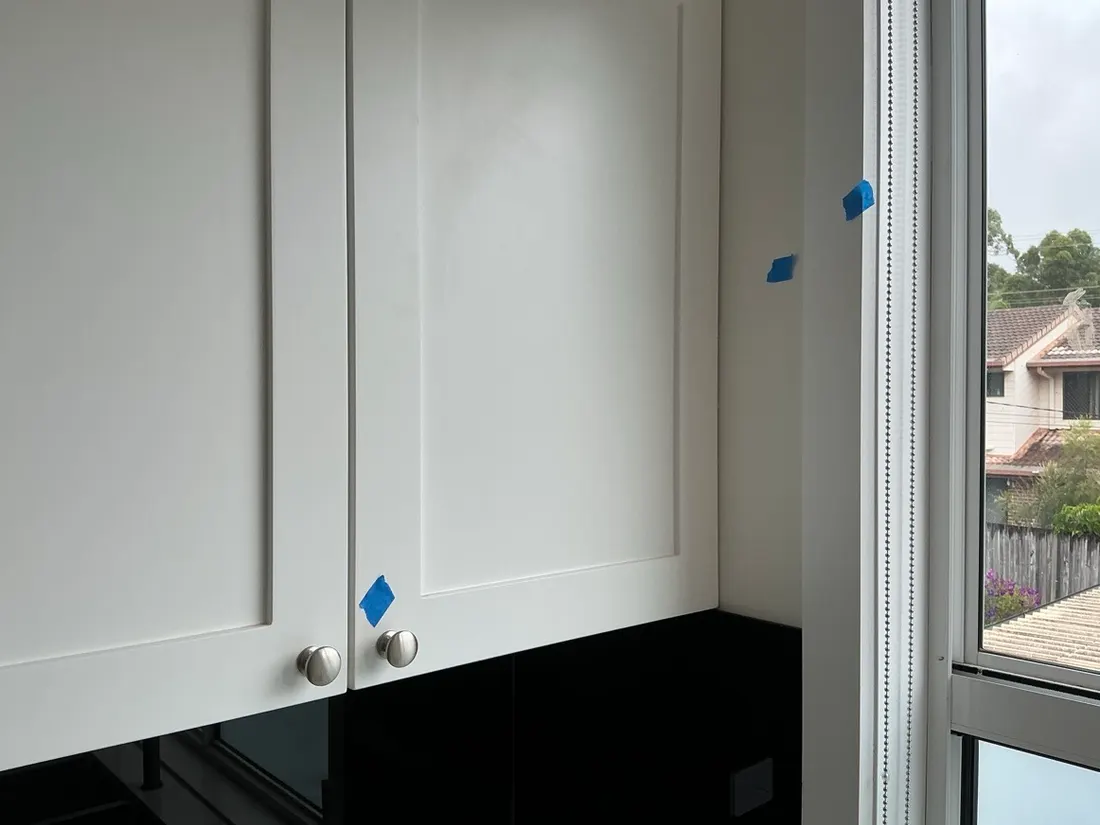
Paint finish. Paint is generally defective if brush marks, roller texture, runs, sags, blemishes or colour variation are visible from about 1.5 m under normal lighting — the same viewing test the guide applies.
Gaps in joinery and trim. Gaps at skirtings, architraves, cornice and cabinetry mitres beyond the guide's stated limits (often around 1 mm for cabinetry joints) are assessable items rather than matters of taste.
The same discipline applies whether the assessment happens at a stage inspection, a PCI inspection or a handover inspection — every finding is tied back to a number, not an opinion.
Where to download the official guide
The Standards and Tolerances Guide is published by the QBCC and is freely available to download from qbcc.qld.gov.au. It is worth reading alongside your contract before handover so you know what the objective benchmarks are. For how we apply it on site — measuring, photographing and referencing each finding — see our inspection methodology, and for a plain-English walk-through of the most common items, our QBCC defects guide breaks them down with real examples.
What can go wrong
The most common source of friction at handover is the absence of an agreed standard. Without the guide, disagreements become a matter of opinion — the buyer thinks something is wrong, the builder thinks it is fine, and there is no objective basis to resolve it. Builders across South East Queensland produce quality homes, and most items raised are routine; the guide simply gives both parties a shared, fair reference for the few that need attention.
The other pitfall is timing. Because some elements carry timeframes, leaving an inspection too late can mean missing the window in which the builder is clearly responsible.
What the guide does and doesn't cover
The Standards and Tolerances Guide covers the quality and workmanship of residential building work. It works alongside, rather than replacing, the National Construction Code and the Australian Standards — the Code and standards set how work must be built, while the guide sets the acceptable quality of the finished result. Used together, they form the basis of a thorough, defensible inspection.
A VG Inspect QBCC-licensed inspector (QBCC Licence 1318443) assesses your home against the Standards and Tolerances Guide on every inspection, giving you a clear, fair view of what is and is not a defect. Call 07 3180 8041 or book a PCI inspection online.